What We Took Away from Glean:Go 2026
_z04nf.jpeg)
Glean:GO 2026, the annual flagship conference hosted by Glean, took place in San Francisco, CA the last week of August. It was a great week for Alchemy. Glean named us its 2026 Delivery Excellence Partner of the Year, the award for its top deployment services partner. Glean also called out the partnership in the opening keynote and invited us to join its technical advisory board. We are grateful for all three.
You can read more about the award in Alchemy’s announcement.
The product news deserves equal attention. Glean is extending its platform from search and answers into work that gets done, with cost and governance controls built in. Most of what was announced is in beta or listed as coming soon, so read this as a planning guide. Below are the four announcements we are discussing with customers, along with the point we make about each.
The larger story is simple: Context is king. Models are becoming more capable, more numerous, and more interchangeable. What remains difficult to reproduce is a trusted understanding of the enterprise: its people, permissions, systems, activity, policies, and business processes. Glean is positioning itself as the context and intelligence layer that can make any AI deployment more useful, more secure, and more economical.
Glean as the enterprise AI control layer
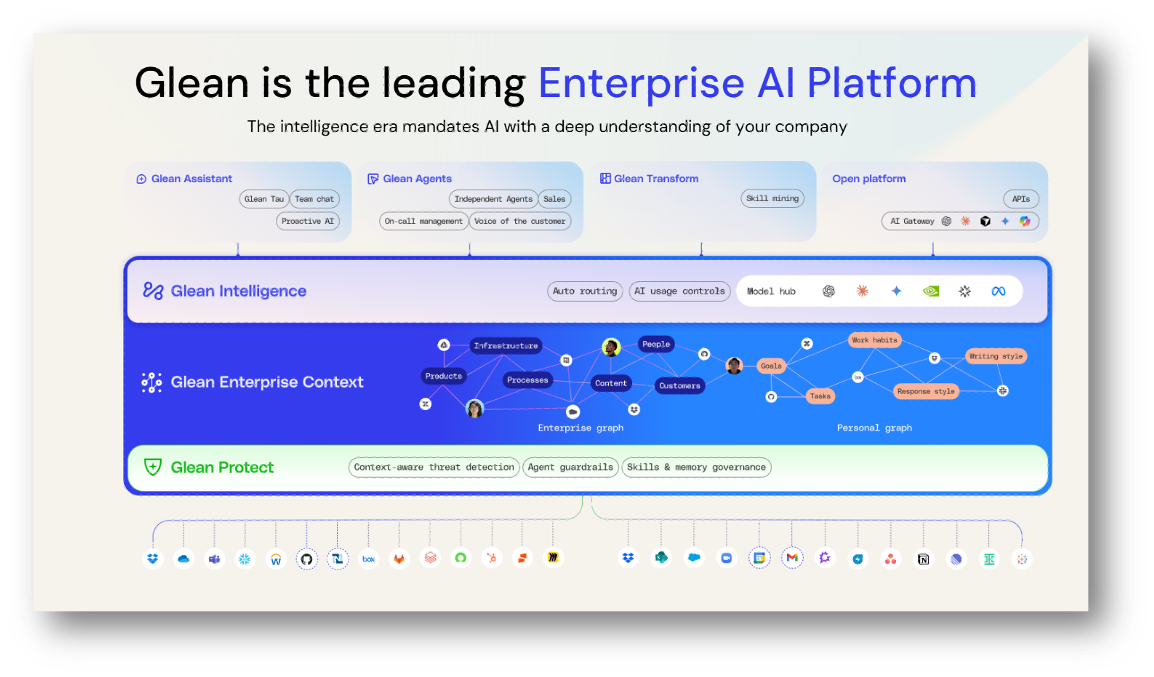
Glean is not only an AI destination for employees. It can also be positioned as a standalone layer behind the AI experiences an organization already uses. That layer can provide:
- Enterprise context: Permission-aware access to the information, relationships, and activity needed to ground AI responses and actions.
- Security and governance: Consistent controls across AI applications, agents, model access, and other entry points.
- Model selection: The ability to route work to the model and reasoning level that best fit the task.
- Cost optimization: Visibility, budgets, and usage controls that help organizations expand AI use without treating model spend as an unmanaged variable.
- Connectivity: A way to bring context from the systems where work actually happens, including systems that require custom integrations.
That positioning matters because customers do not want to replace every AI tool they already use. They want the freedom to use the right interface for each job while maintaining a common foundation for context, security, model choice, and cost control.
Glean Intelligence: model choice with cost control
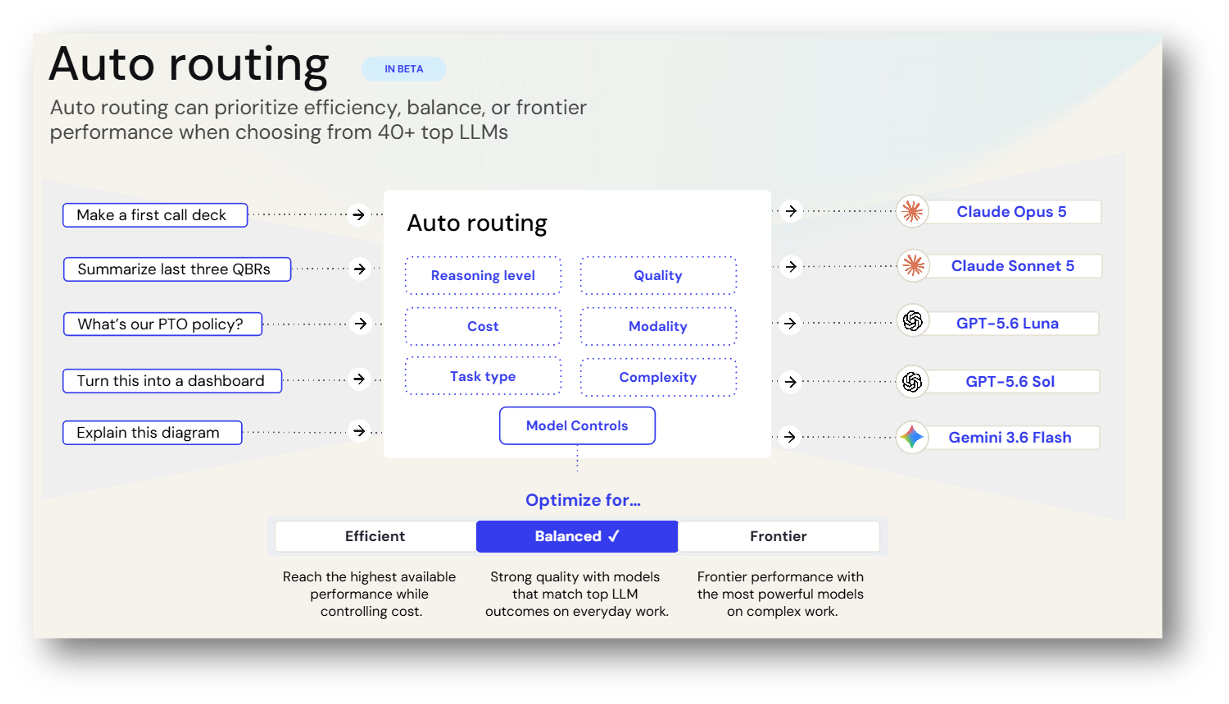
Auto routing, now in beta, selects among more than 40 models based on whether a task calls for efficiency, balance, or frontier performance. Central budgets and usage controls sit alongside it. In its Glean Cowork benchmark, Glean reports 81% lower token costs per task across more than 180 enterprise tasks and says Glean responses were preferred 78% of the time. Customers should test those figures against their own workloads.
Our take: This is where the business case for a central AI platform gets stronger. One platform with access to many models means one security review, one procurement motion, and no repeat model bake-off every time a new model lands. Teams can keep the tools and experiences they prefer while the organization gains a common layer for model selection and spend management.
In the business cases we build with customers, that avoided spend gets its own line next to productivity. Model spend also needs a named owner, and few organizations we meet have one today.
Glean Tau: governed work on the desktop
Tau combines enterprise context with local files, applications, browser workflows, and code, so an agent can plan, execute, and review multi-step work from the desktop. Glean lists it as coming soon. The Glean announcement describes Tau as a way to extend Glean’s enterprise context and controls into local work.
Our take: Tau complements the AI tools customers already use, including Claude and Copilot. The preparation is identity work. An agent that touches local files and code needs scoped access, a clear non-human identity, and a reliable way to revoke it. Customers who settle those questions now will be ready to pilot when Tau ships.
Proactive AI and Glean Transform
A set of valuable capabilities was announced as part of the soon-to-be-released Glean Proactive AI, including Task Management, Email Triage, Meeting Coaching, Team Chat, and Independent Agents. Together, they move Glean toward surfacing and starting work before a user writes a prompt.
Glean Transform applies the same idea at the organizational level. It maps how work happens, recommends where agents can help, and measures impact. The goal is not simply to add more AI features. It is to identify where AI can change the economics of a process and then prove whether the change delivered results.
Our take: These offerings focus attention on process transformation, where enterprise AI value becomes measurable in bottom-line results. The important question is not how many people have access to an AI assistant. It is which workflows are changing, which outcomes are improving, and whether the organization can scale what works.
AI Gateway and Glean Protect
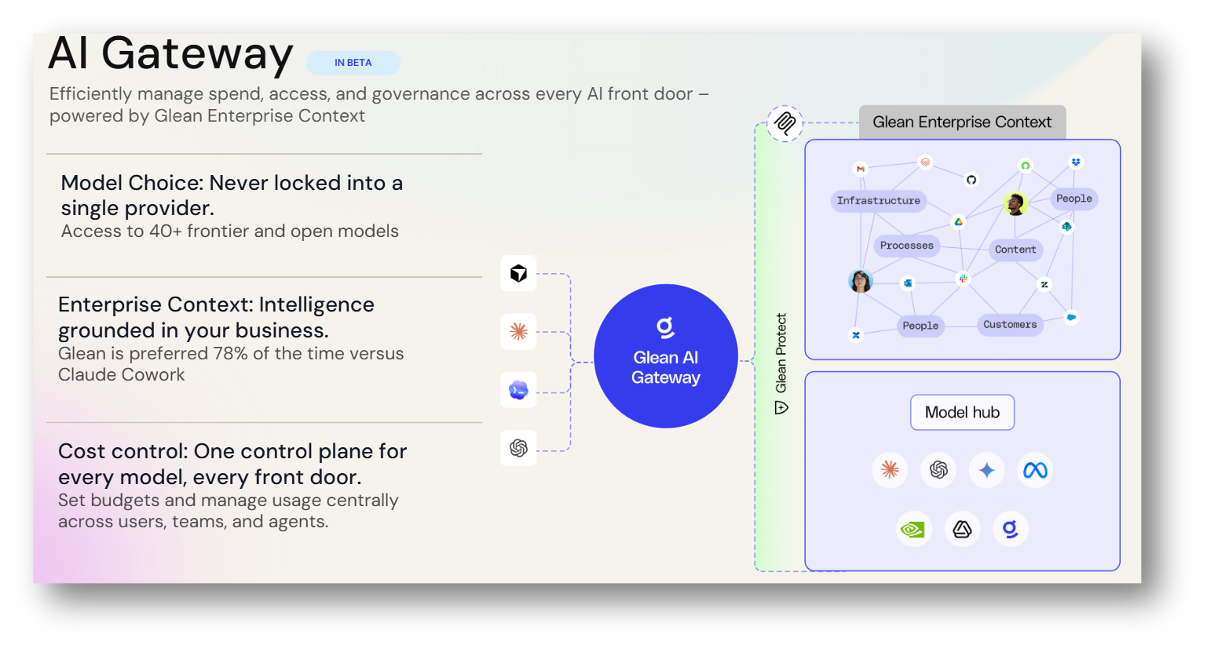
AI Gateway, in beta, provides one control plane for model access, budgets, and usage across AI front doors. Glean Protect adds context-aware threat detection that evaluates the user, the data, and the sequence of actions. It can flag a chain of individually permitted steps that adds up to exfiltration or another risky pattern.
Our take: Customers with agents in production are returning to identity, security, and governance. A common control plane helps, especially as AI spreads across applications and teams. It works best when the groundwork is in place: permissions that are accurate in the source systems, an AI policy with a named owner, and data that has been classified.
How Alchemy helps customers build the foundation
The value of enterprise AI does not come from a product in isolation. It comes from aligning the technology, operating model, and business priorities around a workflow that matters. Companies need end-to-end AI strategy help across the full set of dependencies that determine whether an AI initiative succeeds.
Alchemy brings expertise across the major pillars:
- Identity: Establishing the human and non-human identities, access boundaries, lifecycle processes, and revocation paths that AI systems require.
- Security and governance: Defining policies, controls, threat detection, and accountability so AI can scale without creating unmanaged risk.
- Data: Improving the quality, classification, ownership, and availability of the data that AI needs to produce reliable results.
- Connectivity and context: Connecting the systems where work happens, preserving source permissions, and making the right enterprise context available to Glean and the broader AI ecosystem.
- Business alignment: Selecting use cases with measurable value, establishing executive ownership, and connecting AI investments to the metrics the business already uses to make decisions.
- Adoption and outcomes: Helping teams change how work gets done, measure results, and build a roadmap for what to expand next.
Three elements show up in nearly every Alchemy engagement.
A business case a CFO can sign
We tie the value of Glean and a centralized AI platform to the customer’s stated initiatives in layers: day-one productivity, KPI improvements at 90 days, reduced risk, and avoided future AI spend. Model and tool choice stays open throughout. The business case should explain not only what AI can do, but why the organization should invest now and how it will know the investment is working.
Custom connectors
Many customers run a system at the core of their business that has no native Glean connector. We build those connectors so the context that matters most reaches the platform with source permissions intact. Connectivity is not a back-office detail. It is what determines whether AI has a partial view of the business or the context required to be genuinely useful.
Where to start
- Pick one workflow with measurable pain and a willing team.
- Confirm the foundation: identity and access, security and AI governance, data, connectivity, and enterprise context.
- Baseline the KPIs before go-live.
- Decide where Glean should serve as the user-facing experience and where it should operate as a context, security, and model optimization layer behind other AI tools.
- Review results at 90 days, then expand.
Context is king because AI can only be as useful as its understanding of the business. The organizations that pull ahead will not simply adopt more models or deploy more agents. They will build the context, controls, connections, and business alignment that allow AI to work safely and effectively at scale.
We would love to tell you more about Glean and how we engage with enterprise organizations to build AI platforms that generate measurable value at scale. Contact Alchemy.
Authors
 Chris Hogan
  Andy Quirin