The Rise of the AI Customer: How to Prepare Your Business for the Shift From B2B and B2C to B2AI
At Alchemy, we are starting to see a new customer take shape in the market: an AI agent acting on behalf of a person or a business. This is not just another chatbot or sales channel. It is a new path to revenue, where agents discover, evaluate, and transact with businesses on behalf of their principals.
We’re seeing this emerging model labeled as Business-to-AI, or B2AI. The opportunity is straightforward: become visible, trusted, and easy to transact with for a new target audience before competitors do.
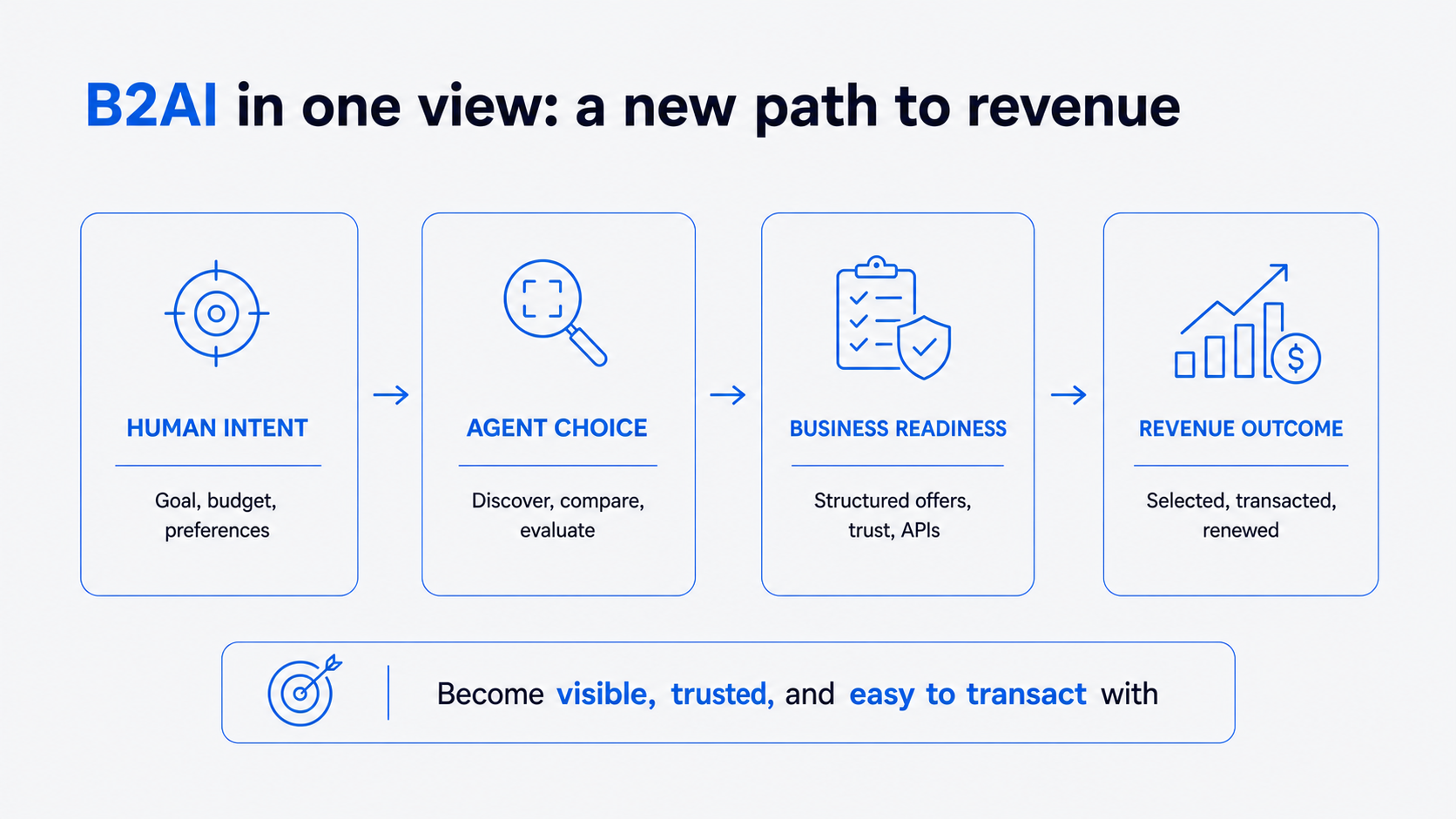
Figure 1: B2AI connects human intent to agent choice, business readiness, and a new revenue outcome.
Alchemy’s market view: the AI consumer is not a future persona to monitor. It is an emerging route to monetization, and businesses that become legible to agents first can win demand before it is routed to an intermediary or a competitor.
This Is Not a Someday Trend
It is tempting to file this under "interesting, but years away." The numbers say otherwise. McKinsey estimates that agentic commerce could orchestrate $900 billion to $1 trillion in US B2C retail revenue and $3 trillion to $5 trillion globally by 2030. These figures are opportunity estimates for goods, not a measurement of current sales, and they exclude services and the significant B2B market. Gartner predicts that by 2028, 90% of B2B buying will be AI-agent intermediated, pushing more than $15 trillion of B2B spend through AI-agent exchanges. Adobe reports that AI-source traffic to US retail sites grew 393% year over year in Q1 2026. In its official Digital Insights webinar, Adobe reported that AI-source traffic converted 42% better than non-AI traffic in March 2026. Salesforce found that AI and agents influenced $67 billion, or 20% of global orders, during Cyber Week 2025.
The direction of travel is unmistakable. The only real question is whether your business will be legible to these agents when they arrive, or invisible.
How an AI Customer Actually Behaves
Serving an agent well requires unlearning a few habits built for human buyers. Agents do not read marketing copy or admire a well-designed homepage. They need structured, machine-readable data about your products, prices, inventory, eligibility, and policies through APIs and protocols such as the Model Context Protocol. They favor offers that are clear and consistent, and they skip anything ambiguous or hard to parse. Optimization therefore shifts from ranking only in traditional search to being understandable, cited, and selected by generative systems. When it is time to act, an agent needs verifiable authorization and a payment path that can operate within the customer’s mandate.
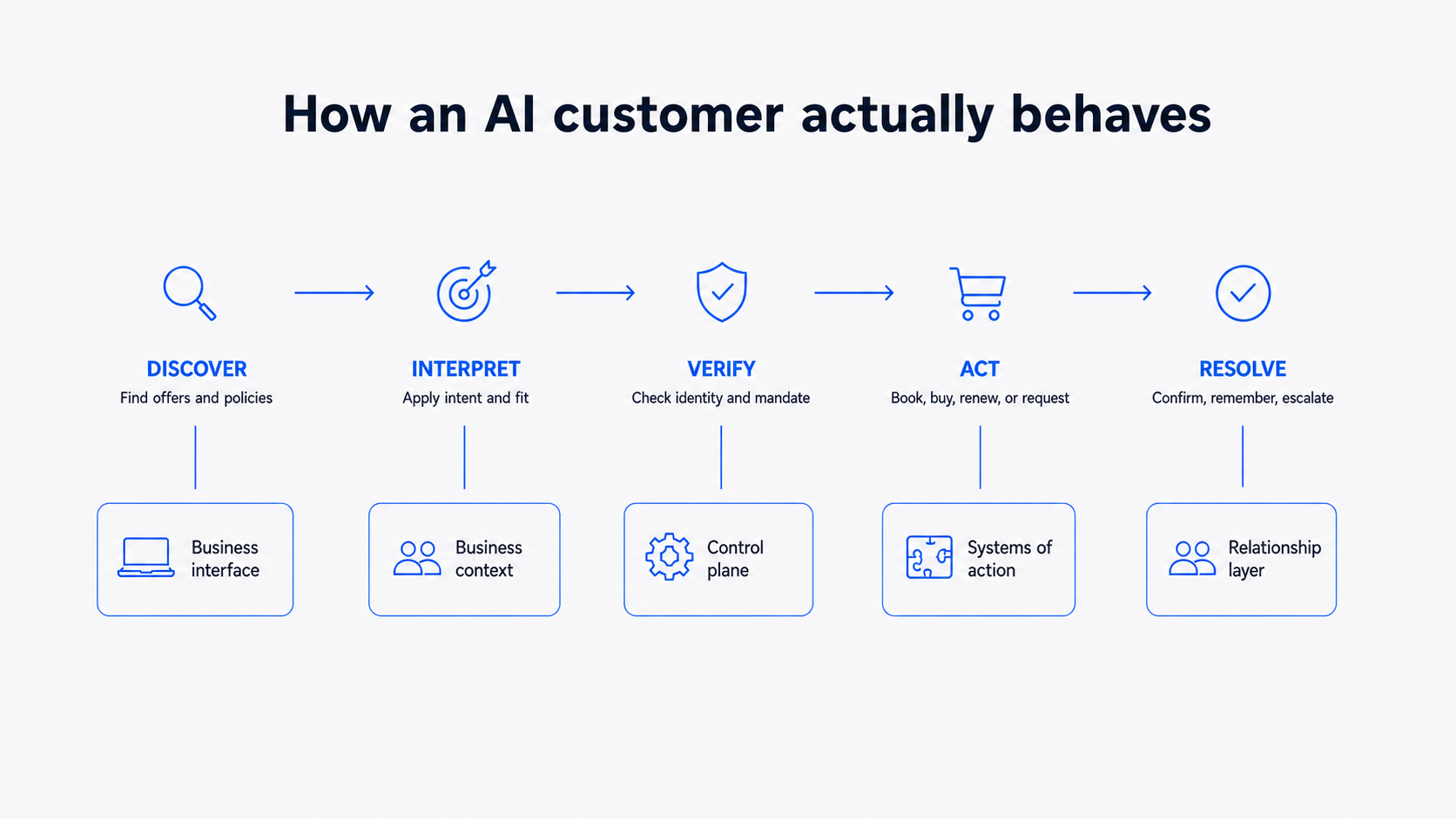
Figure 2: An AI customer moves from discovery through interpretation, verification, action, and resolution, supported by a governed business architecture.
This Impacts Even the Most Human Industries
The reframe that matters most is this: not serving agents today does not mean you will not soon. Even traditionally high-touch, human services are moving toward agent-mediated transactions faster than expected. Assume you are next.
Consider an airline. A traveler may delegate a disruption, rebooking, or fare comparison to an agent instead of navigating the airline’s app. Consider a pharmacy, where routine refill status, reminders, and renewal workflows can increasingly be handled by an agent while clinical or controlled-substance decisions remain with a pharmacist. Consider a hotel, where an agent can search, compare, and book a room in one conversation. And consider B2B, where Gartner’s projection puts 90% of B2B buying through AI-agent intermediaries by 2028. These are not claims that every industry has already completed the transition. They are examples of where the customer journey can move first.
In every one of these verticals, the first interaction is becoming agent-to-business. Brands with fragmented or human-only data quietly disappear from the agent's shortlist.
The Questions Every Business Should Be Asking Now
The path forward starts with a handful of honest questions. On discoverability, can an agent find, parse, and correctly interpret your products, prices, and policies without a human involved? On transactability, can an agent complete a purchase, a refill, or a booking with you end to end on the rails agents actually use? On trust and identity, how do you verify an agent's authority to act, prove consent, and resolve disputes when the buyer is not a person? On experience and loyalty, are you designing an agent experience alongside the customer experience, and what does loyalty even mean when decisions are delegated? And on readiness and ownership, who owns your B2AI strategy, what data must be exposed and governed, and where will you run the first pilot?
What Actually Has to Get Done
Turning those questions into action follows a clear sequence. Begin by assessing whether your catalog, pricing, and policies are machine-readable today, and test whether an agent can actually find and transact with you, so you can see where traffic is already leaking to intermediaries. Then expose that information properly by standing up the semantic layer, product and pricing APIs, and MCP endpoints that let agents reason over trustworthy, real-time context. Enable transaction on at least one flow by adopting an agent payment protocol and adding consent trails and dispute handling. Throughout, govern agents as a new class of customer and workforce, extending identity, access, spend limits, and monitoring to non-human actors as part of your broader AI governance program. Finally, optimize for the long term by shifting to generative engine optimization, structuring your trust signals, and instrumenting analytics on agent-driven demand so you protect the direct, commission-free relationship.
A Clear-Eyed View of What Could Slow This Down
None of this is inevitable on a fixed timeline, and a credible strategy acknowledges the friction. Visa’s research shows that consumers are more comfortable with AI helping compare and decide than with fully autonomous action, making visibility, control, and override important adoption requirements. Reliability is a real concern, as recommendation poisoning and prompt injection can steer an agent toward the wrong vendor or a bad purchase. Security and ownership also need to mature as organizations create more non-human identities and delegated workflows. Legal exposure is not theoretical: Gartner predicts that “death by AI” legal claims will exceed 2,000 by the end of 2026. The lesson is not to wait, but to move with governance, measurable outcomes, and business-led focus rather than tool sprawl.
How Alchemy Can Help You Get There First
At Alchemy, we help leaders turn this emerging market shift into a practical strategy. Our AI team will sit down with you in a Strategy Mastermind workshop to outline how AI customers are likely to impact your industry, your customer journeys, and your revenue model.
Together, we will:
- Map where agents will discover, evaluate, and transact in your industry.
- Identify the functions and customer journeys most likely to change first.
- Surface the data, identity, governance, and integration work required to become agent-ready.
- Prioritize the opportunities that can create new revenue or protect demand from intermediaries.
- Build a practical roadmap for getting ahead of the market, starting with a controlled pilot.
The output is not a generic AI wish list. It is an industry-specific view of the AI customer, the monetization opportunities it creates, and the steps your business can take now to become one of the companies agents choose first.
The AI consumer is emerging across airlines, pharmacies, hotels, manufacturers, professional services, and every other industry. Let’s sit down with your team and get your business ready before the opportunity reaches your competitors.
Sources
- Visa, The next era of commerce: When AI is the customer
- McKinsey, The agentic commerce opportunity
- Gartner, Top predictions for IT organizations and users in 2026
- Adobe Digital Insights, AI traffic grows but retail sites lag in AI search visibility
- Salesforce, Cyber Week and AI-driven sales
- Coinbase, Introducing x402
- CryptoNews, Coinbase x402 agent adoption figures
- Chainalysis, 100M agentic payments on Base
Author
 Andy Quirin